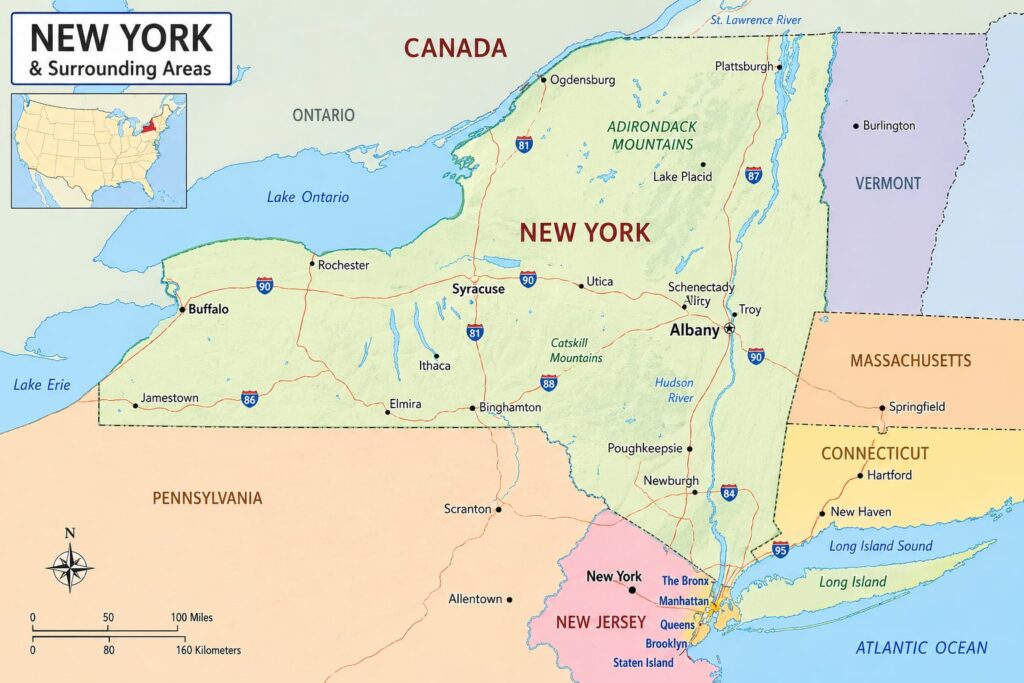
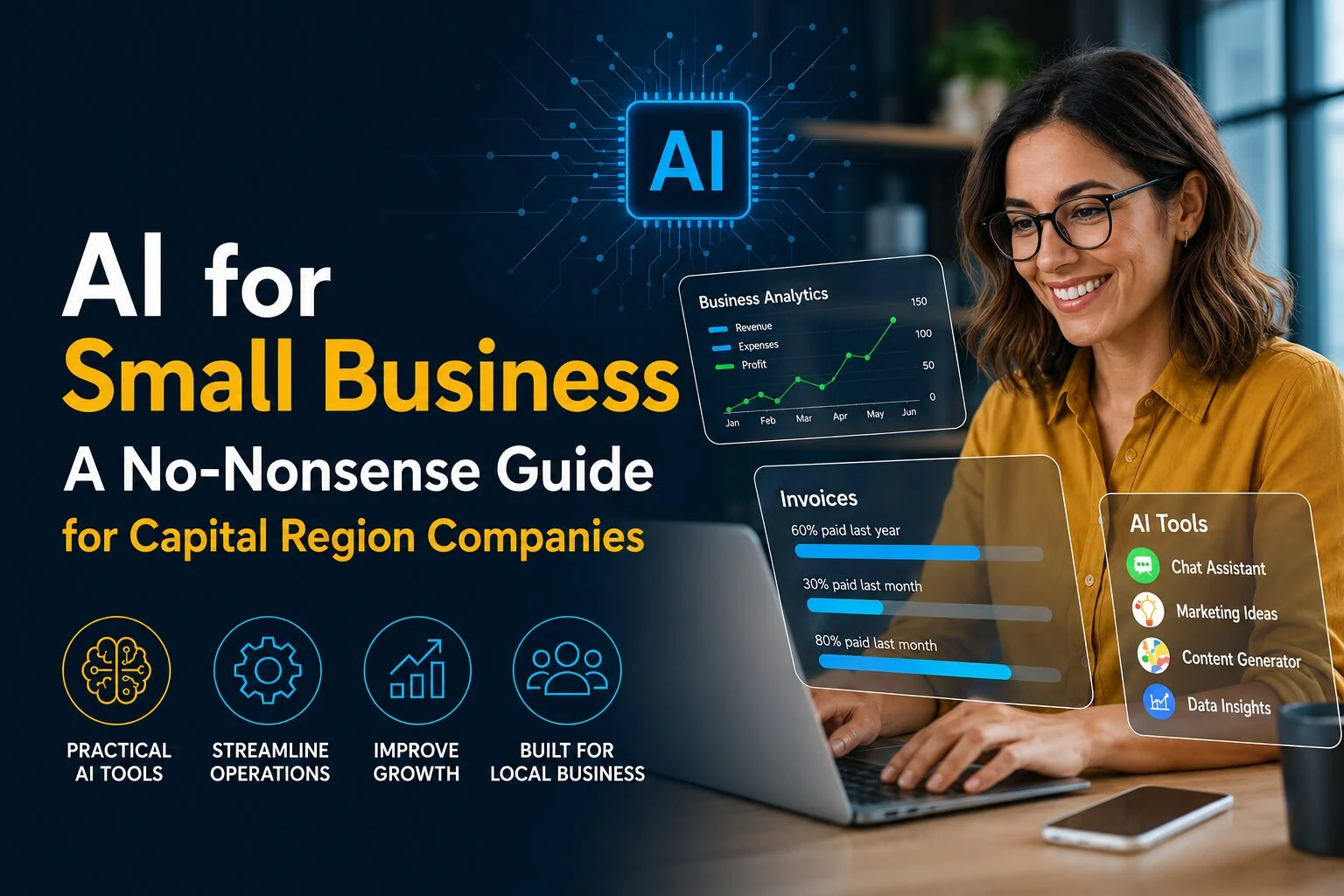
Most pieces on AI for small businesses are written by people who have never owned a small business. They speak of “transforming your enterprise” with technology developed for 500-person teams. If you own a store in Albany, a services firm in Troy, or an expanding organization in Schenectady, you do not need a transformation. You need an understanding of precisely which AI applications will save you actual time and money this quarter, without spending a fortune on buzzwords.
That transformation is already underway around you: the utilization of small-business generative AI technology increased from about 40% to 58% between 2024 and 2025, according to the U.S. Chamber of Commerce, while firms using AI state that it’s increasing their revenues in the vast majority of cases, according to SMB research by Salesforce. This guide avoids the buzzwords and dives into the places where AI is actually helpful for small businesses, costs at all price levels, risk factors not mentioned in other guides, and how AI is being used in local Capital Region companies.
What is “AI for Small Business”?
Cut through the buzzwords, and all you’re really talking about is software that can do the writing, organizing, predicting or responding faster than you could on your own. That’s it. It isn’t a robotic replacement for your employees – it’s just some tools that give back some of those precious hours to your team each week by drafting the rough first draft of your blog post, answering questions from customers at midnight, and highlighting the leads that deserve your immediate call.
It’s not necessarily the companies with the most money making the biggest difference with AI right now; it’s the ones that have used two or three tools that actually solve a problem, rather than trying to “AI-fy” everything all at once.
Where AI Actually Makes a Difference for Small Businesses
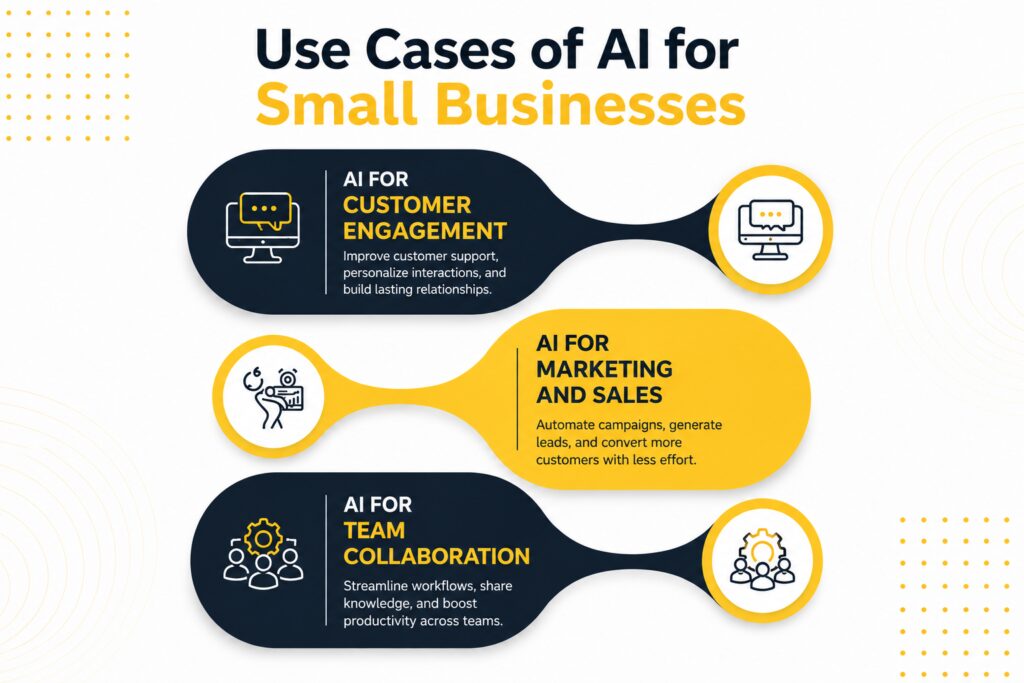
1. Marketing & Lead Generation
Here’s where the ROI comes quickest for small businesses – and the part that nearly every generic “AI in business” article out there fails to mention at all. 77% of SMBs cite marketing & customer engagement as the only focus for their AI investments, according to a study by Salesforce, and the reason is simple: AI-driven SEO content, ad bid management, and lead scoring allow a five-person marketing team to compete against a fifty-person team.
Example: an HVAC company in your community using our AI-powered lead generation technology ensures every inbound form-fill is automatically scored and sorted based on its urgency, ensuring a request for same-day service does not get overlooked among a request for maintenance.
2. Customer service and communication
Chatbots and other automated tools deal with the routine part of customer inquiries about time, price, and availability so that your employees only deal with cases requiring a human touch. Companies relying on AI-enabled chatbots have seen customers’ response time fall by about one-third, claims research from Zendesk. And fast response has been shown to have a direct impact on customers staying loyal to your brand. That is, for a small local company, it means that a potential client contacting you on Sunday evening will receive immediate assistance, not be ignored until the morning of the next working day, when most businesses win the deal.
3. Operations and Administrative Tasks
Schedule management, invoicing, inventory management, and expense classification are areas that can be automated with the help of AI technologies. None of them are fancy, but those are usually the tasks during which small business owners spend too many hours without being paid. According to the researches, AI can help you save from 3 to 7 hours per week for administration for small service businesses. The more complex is the communication with clients (for example, consultants and contractors, as well as companies from the healthcare and wellness area), the more benefits will come from it.
4. Sales & CRM
CRM supported by AI technologies is able to recognize the contacts that have a higher probability of conversion, write automatic follow-ups, and summarize phone calls, thus making the sales funnel that was kept by one person visible for everyone else. Another use case for AI in sales is the Customer Data Platform. Instead of using the data from your website visits, ad clicks, and CRM separately, CDP allows AI to make some recommendations based on all of this information.
5. Content Creation and Creative Writing
From initial drafts of blog posts to writing social media and advertisement content in different variations, AI tools can accelerate content creation. In other words, content creation is the number one application of AI technology in use by small businesses in nearly all significant surveys. However, unedited content created by AI technologies may sound just like any other company’s since it is written with no consideration of the local voice, correct details, and appropriate style of writing. This is how a small business sounds like a generic template.

A Budget-Broken Down List of AI Tools for Small Businesses
Most of the articles on the web list tools but don’t give an understanding of their cost of usage for small businesses. Here is the actual picture:
Budget Tier | Best For | Example Tools | Realistic Use Case |
Free – Under $50/mo | Solo operators, testing the waters | ChatGPT, Google Gemini, Canva AI, Grammarly | Drafting social captions, cleaning up emails, basic image edits |
Growth – $50–$300/mo | Businesses with 5–25 employees | HubSpot AI CRM, Jasper, Otter.ai, Zapier AI | Automated lead follow-up, meeting notes, workflow automation |
Scale – $300+/mo | Multi-location or high lead-volume businesses | Custom CDP platforms, AI-powered PPC bidding, predictive analytics tools | Cross-channel attribution, dynamic ad bidding, customer-lifetime-value modeling |
Risks No One Ever Told You About
- Every single “AI for business” piece published online reads like a list of advantages. It’s not only unethical but also not the way to gain someone’s trust when trying to decide whether to invest. And here’s what you should look out for instead:
- Privacy issues: most free AI software uses your input to learn from it and develop its model. Your customer information, agreements, and finances should not be uploaded to the chatbot.
- Overdependence: AI generated drafts have to be reviewed by a human. Particularly, any communication with customers and documents of a legal nature must be reviewed.
- Expenses: add-ons based on the “per seat” AI to your current software will cost you much. Make sure that you really need all of those services quarterly.
- Diluting your brand voice: the raw AI content sounds artificial. When a customer finds out that it was written by a machine, not a human, you lose more trust than save money on writing.
- Loss of customer trust: informing a client whether he or she communicates with a chatbot/automated message or a human representative has become one of the best practices.
AI in the Capital Region: Here’s How It’s Really Being Used by Local Businesses
Working with SEO Leadz revolutionized the way we market our business. Using their SEO and content strategies powered by AI technology enabled us to cut content development time by 70% while simultaneously growing our number of qualified leads by 46% in only five months. This team knows how to help local businesses succeed.”
– Sarah Mitchell, Marketing Director, Capital Home Solutions (Colonie, NY)
“AI was something we had reservations about before working with SEO Leadz and learning to incorporate it into our business. But from SEO to lead generation, all their recommendations were highly effective. In the first six months of working with them, we saw our organic traffic grow by 81% and inquiries double.”
– Michael Roberts, Owner, Empire Roofing & Exteriors (Albany, NY)
This is not something that’s discussed in some fancy business book about Fortune 500 companies. This is local businesses right here in the Capital Region using the same technology to generate leads and optimize their SEO.
A Realistic 90-Day AI Implementation Plan
- Days 1–30: Select one bottleneck (lead follow-ups, content creation, or customer reply times) and deploy one tool to overcome it.
- Days 31–60: Assess the impact. Monitor time savings or lead recoveries before introducing a second tool.
- Days 61–90: Introduce a second bottleneck after the first is proving its worth, and establish a review process for all AI-generated material before it is sent to the customer.
DIY or Agency Collaboration?
Absolutely! You could definitely start from the free option and DIY it. In most cases, small businesses do that. It becomes complicated when you need to integrate your AI tools into one strategy – to coordinate AI-based SEO content, lead scoring, and PPC bidding to operate with the same data source rather than three different subscriptions.
This is the difference SEO Leadz makes. We are among the few agencies operating in the Capital Region who unite AI-based SEO services, a proprietary CDP, and lead generation activities into one agency.

Hi, I’m Kashaf Attiq, founder of SEOLeadz. From custom web development and content writing to advanced SEO and guest posting, I turn websites into powerful, lead-generating machines. Stick around for actionable tips, or reach out to scale your business!