
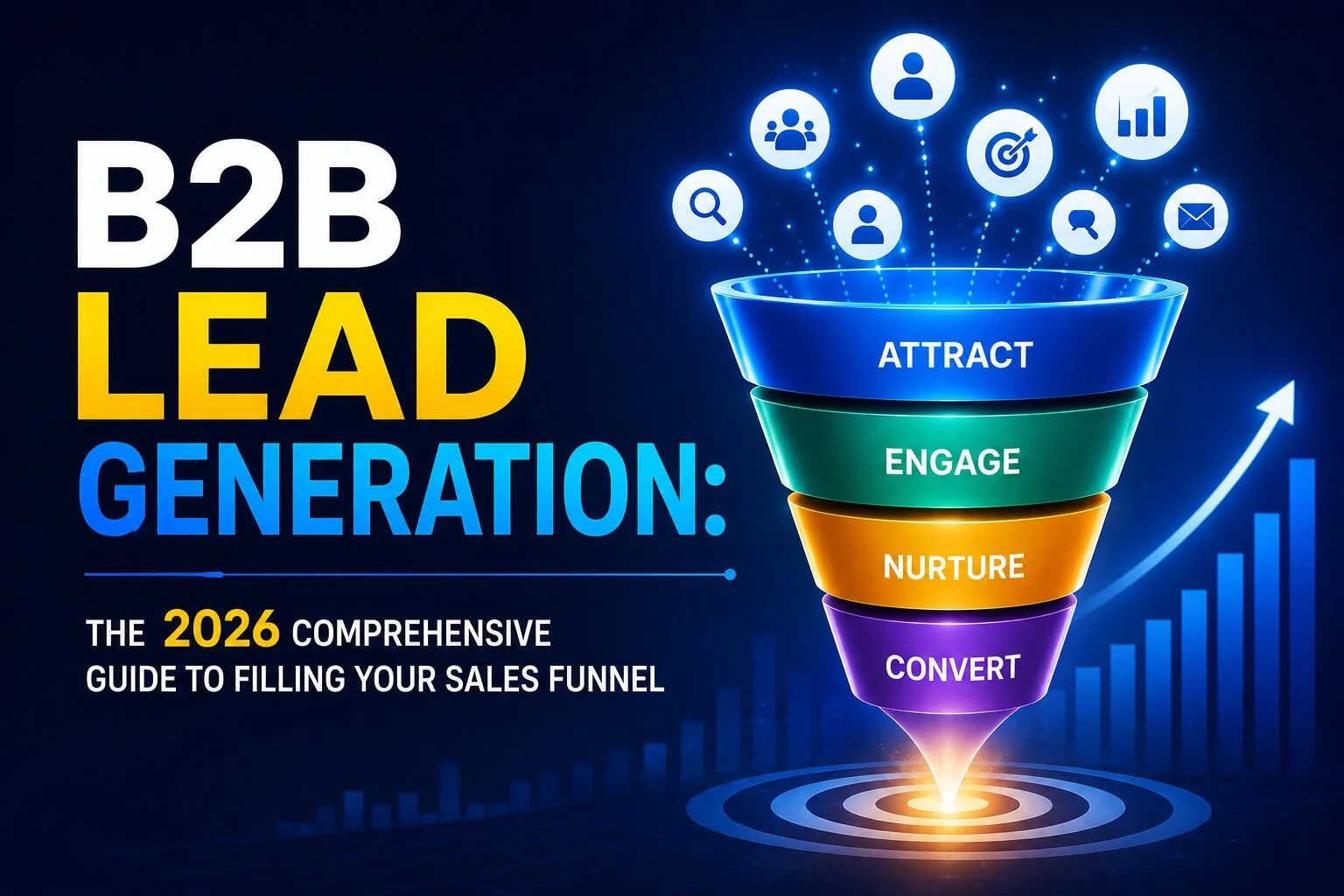
B2B lead generation is the process of identifying business prospects, getting their attention, obtaining information about them, and qualifying them to make a sale eventually. There are more steps to B2B lead generation than B2C marketing and many other variables to take into account.
But the aim of B2B lead generation isn’t about acquiring leads regardless of anything else. Instead, the goal is about finding the right leads, which means identifying the prospects that match your ICP and have a need for your product. In this guide, we are going to show you how to do all of this and more.
Table of Contents
What Is B2B Lead Generation?
In simple terms, b2b lead generation is finding, catching, and converting other companies into your customers. Just as in fishing, where you need to identify which fish is going to bite in which lake, at what time of the day, etc., in B2B marketing lead generation, you need to identify which company will buy your product or service.
Meaning of b2b lead generation is not only cold calling or emailing. On the contrary, it includes everything which happens from the moment your potential client learns about your name until they sign a contract with you.. Building relationship with decision makers – who actually have a budget and report to stakeholders – is the most important aspect of this process.
What Makes a B2B Lead Qualified?
Not everyone who downloads an ebook, fills out a form, or visits your website is necessarily a qualified B2B lead. A good lead will meet the criteria of your customers and have the capacity to be one of your customers.
Here are some factors that could be taken into account to determine the quality of the lead:
ICP Fit: Is the company in the desired industry? Are there any other criteria – size, location, revenue, technology stack, etc. – that can be used for qualifying the lead?
Business Need: Does the prospect face any problems/needs that your product/service solves?
Decision-Maker: Does the person who contacted you have the necessary authority to make purchases on behalf of the company?
Timing: Is the company actively searching for the solution to its problem at the moment? Or is the problem/hypothesis rather theoretical?
Buying Intent: Are there any actions of the prospect such as requests for demos, visits to the pricing page, downloads of informative materials, replies to the outreach, etc.?
What Is the Difference Between an MQL and an SQL?
The MQL is someone whose interest levels or attributes have reached such a high level that there is a potential that the person can be a buyer of what the company has on offer.
On the other hand, the SQL is a prospective buyer whose level of intention is higher and who qualifies for direct sales follow-up.
In other words, if a person downloads an industry generic guide, they become an MQL. If the same person shows further interest by requesting a demo, browsing pricing details, and fitting the company’s ICP, they can become an SQL.
The definitions of an MQL and an SQL need to be worked out between the marketing team and the sales team.
B2B Lead Generation Example
Take for example, a B2B software company selling project management software to medium sized technology companies. Rather than aiming for all types of businesses, the company narrows down its ICP to technology companies with 50-500 employees who have distributed teams…
It produces content that talks about project management difficulties, gives out a checklist for implementation, catches interested prospects via a landing page, and finally qualifies them according to company size, job function, need, and purchase intent.
How Does B2B Lead Generation Work?
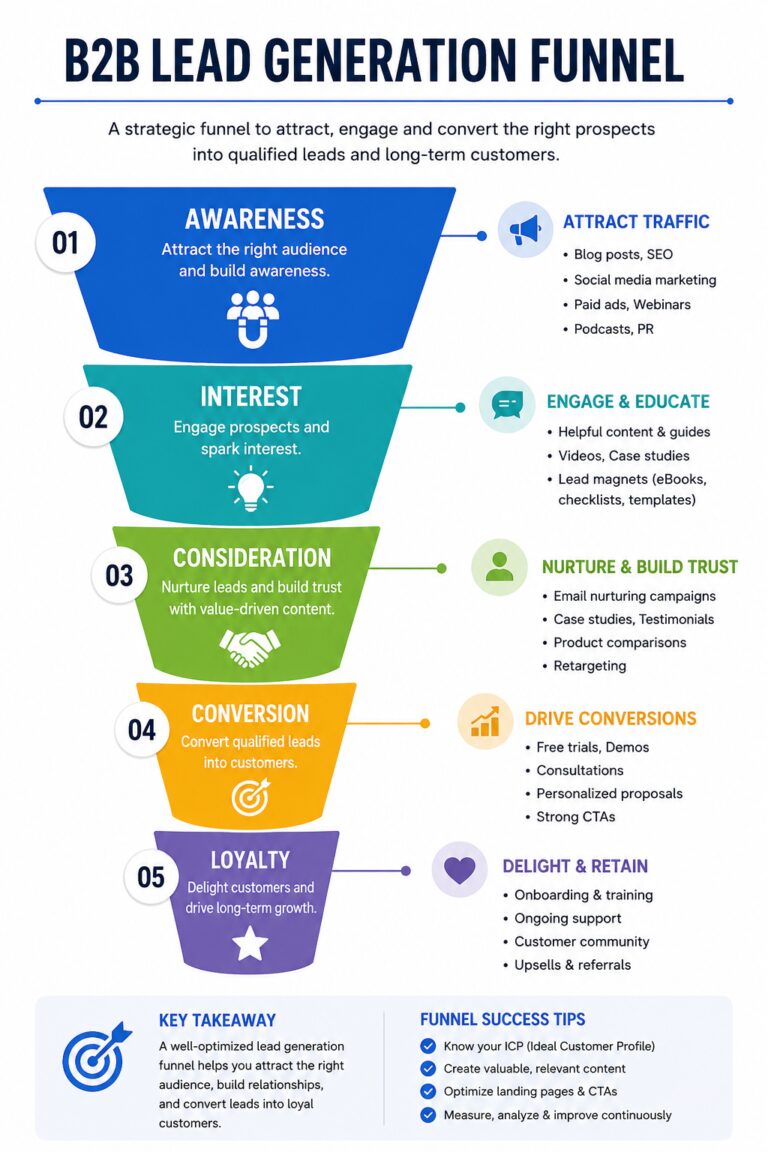
Lead generation for B2B is a process-driven approach, rather than a marketing task. First of all, a business must determine which organizations and people it wishes to target, attract these prospects through appropriate means of contact, collect information about them, and nurture these leads according to their requirements and purchasing intent. The main aim is to guide the right prospects into a sales discussion.
1. Define Your Ideal Customer Profile
Before even creating leads, it is important to understand whom you wish to target. An Ideal Customer Profile is a specification of the kind of company that would profit the most from your product or service. This includes industry, size, revenue, location, technology stack, business model, and pain points.
An ICP allows marketing and sales teams to concentrate their efforts and money on customers with a higher potential of a match than on everyone else.
2. Attract the Right Prospects
After determining your ICP, the next phase will be to reach out to those people through the channels that they actually use. These channels could be any of the following: Google, LinkedIn, publications, email, advertisements, events, collaboration or education based on your audience.
The best channel is determined by where your buyers look for solutions and which stage they are at in their purchase process.
3. Capture Lead Information
Attracting an interested buyer is just the first step; you also need a process by which that interest will be turned into a lead.
The most popular forms of leads capture are contact forms, demo request, consultation forms, subscription forms for newsletters, downloadable material, webinars, and free trials. The offered value should be worth the exchange of contact information for the prospect.
4. Qualify Leads
However, not all leads that are captured deserve immediate sales attention. Qualifying enables us to find out if the prospect fits our ICP, if there is a legitimate business requirement, if they are the decision-maker, and if there is sufficient purchase intention for us to pursue them further.
5. Nurture Prospects
There are some people who are interested but are not willing to buy immediately. Lead nurturing will help you stay connected until the prospect does further research or makes up their mind on when to buy.
The lead nurturing process may involve educational materials, emails, case studies, product information, webinars, and personalized follow-up. The idea is to supply relevant information without pressurizing the prospect with your sales talk.
6. Convert Opportunities
In the case that a qualified lead shows enough interest and intention to buy, the attention turns to conversion. This might be anything from scheduling a sales meeting, getting a quote, taking a trial, having a demo, or making a purchase.
The marketing and sales departments need to have guidelines as to when a lead is ready to be directly approached by the sales department.
7. Measure and Optimize
Generation of leads in B2B shouldn’t only focus on the number of leads that have been generated but also consider the quality of leads, conversion ratio, cost per lead, sales qualified leads, opportunities, customer acquisition, and revenue generation.
Examining these metrics will allow you to determine which campaigns are creating valuable customers and which ones need to be improved.
Why Is It Important That Your Leads Are Business-To-Business, Not Consumer-Based?
There are distinct differences between B2B and B2C purchases in aspects such as the buying process, decision makers, purchasing value, and time spent evaluating purchases. Purchasing B2B items involves a number of people who need to conduct considerable research before reaching a decision. For that reason, B2B lead generation has to be done properly.
Why a Systematic Approach Always Trumps Random Outreach
It happens all the time – business after business wasting money on ads or cold calls without any strategy at all. It doesn’t matter how many ads or leads you have – it matters whether or not you have an efficient process for defining your ICP, choosing channels, gathering leads, nurturing and converting.
Four Types of B2B Leads (and How to Manage Them All)
Not all types of B2B leads are created equal. To lump all of them together would undoubtedly be one of the most expensive mistakes you could possibly commit. Picture your leads as you would the passengers at an airport. They may all be boarding their flights, but there are definitely those that haven’t passed through security yet. That is how critical the stage of your leads is.
Here are the things you have to find out about your leads in order for you to collaborate effectively with the marketing and sales team:
Lead Type | Who They Are | Behavior Signals | Best Next Action |
IQL | Early explorers | Reads blogs, searches topics | Educational content, awareness ads |
MQL | Engaged researchers | Downloads guides, attends webinars | Email sequences, case studies |
SQL | Ready-to-buy prospects | Books demos, requests pricing | Fast-track to sales within hours |
PQL | Active trial users | Heavy product usage, feature exploration | Targeted sales call + upgrade offer |
SQLs: Your Most Critical Asset Right Now
This is an SQL, which is a buyer who shows interest. They may have requested a demo or price quotes, showing they wish to make a purchase. As per the statistics given by InsideSales, there is a 100X higher probability of being able to contact an SQL within five minutes than after 30 minutes.
MQLs Are Tomorrow's SQLs — Don't Overlook Them
MQLs are interested individuals that aren’t quite ready for sales interaction yet. The wrong thing teams do is wait for them to become sales-ready and ignore them until then. What you should be doing is nurturing them continuously using the right emails and content pieces. As per the State of Prospecting 2024 survey by Sopro, close to 50% of B2B people find it tough to convert MQLs to SQLs.

The Best B2B Lead Generation Methods for 2026
Some of the best ways of generating B2B leads will all depend on the nature of the business you are running as well as your specific target audience, sales cycle, industry, and the budget that you have. Some of the techniques used include SEO/content marketing, networking on LinkedIn, email outreach, paid marketing, and referral marketing.
There are many companies that prefer using multiple marketing channels rather than focusing on one channel to get their leads from. Using inbound techniques like SEO and content marketing might help you generate some visibility, while using outbound techniques like email outreach can make you take a proactive role in reaching out to the prospects.
LinkedIn: Always the Best Way to Contact B2B Audience
More than 55% of the B2B buyers use LinkedIn to do some preliminary research before placing even a single call. With the help of LinkedIn Sales Navigator, one can filter the people depending on their job title, company size, industries and level of experience and can send personalized invitation messages looking as very human. The LinkedIn outreach continues being one of the most affordable sources of leads we provide our clients at SEO Leadz.
SEO and Content Marketing for B2B Lead Generation
Think about your next possible client searching for a solution you offer, but ends up on your competitor’s page instead. SEO and content marketing can be used to bring your company into view while the prospect is researching issues, considering different solutions, and searching for the service provider.
The aim of your company is not just to get ranking for certain keywords; your content should provide an answer to the question raised by the prospect and motivate them to stay longer. Resources helpful for the client will increase credibility while motivating the interested visitor to take further action.
Cold Emailing & Outbound: Getting Leads Fast When Done Correctly
However, cold emailing can be a productive activity provided that it is personalized and targeted well. In most cases, mass emails tend to yield negative results since generic emails may not necessarily capture the needs of the prospect. When the prospects are targeted according to the industry they belong to, the current state of the company or even pain points, then there would be greater relevance than sending the same template to everybody.
Referral Programs: The Underused High-Impact Source
Consumers trust their personal referrals in no small part – a full 92%. In B2B, too. Referrals result in better conversion, higher closure rate, lower churn. Only 11% of salespeople actually ask for referrals regularly, however. Create a referral system and see your lead quality soar instantly.
B2B Lead Generation Benefits Other Than Just “More Leads”
Knowing the complete list of B2B lead generation benefits allows you to argue the need for a proper budget allocation to your superiors and develop a more efficient strategy overall. The first advantage is an increase in the consistent flow of qualified opportunities. Nevertheless, there are other advantages, including brand authority, sales and marketing synergies, and understanding of the target market.
A good lead generation strategy reveals additional market insights too. Analyzing what content brings in the best leads, what sources generate leads and how do certain messages work allows you to gain a continuous source of feedback for all of your future campaigns. That is why SEO Leadz and similar agencies prevail over single solution providers.
Main Advantages in a Nutshell:
Predictable revenue flow
More efficient ICP targeting
Faster sales cycle
Higher marketing ROI
Brand authority in your industry
No wasted money on ads
Sales-marketing integration
AI Changes the Way B2B Lead Generation Is Done in 2026
AI is becoming more useful for B2B lead generation, specifically for purposes such as lead scoring, prospecting, personalization, follow-ups, and workflow management. Rather than replace the whole process of lead generation, AI can assist in analyzing prospect information and identifying possible buying indicators.
The technology helps to determine who your highest intent prospects are through behavior analysis and sends out the personalized sequences, automate the follow ups and gives valuable insights for every single contact point. What used to require the efforts of five marketers can now be done by one with the help of AI.
Hyper-Personalization: Current Key to ROI Growth
Generic emails are ignored within seconds; personal ones receive responses. The current key to getting the highest conversions when creating an email outreach strategy for generating B2B leads consists in customizing your messages according to the role of each prospect in a company, their challenges, and their recent actions along with posts on LinkedIn.
Intent Data: Connecting With Buyers At The Optimal Time
Intent data solutions help you determine which companies are currently researching options like yours. If you connect with buyers who are currently engaged in the research phase, your response rate will sky rocket. Bombora and G2 Buyer Intent allow this information to be integrated with your CRM, meaning your salespeople will know exactly who to call and when.
B2B Lead Generation Tech Stack You Don’t Need
It’s important to remember that your tech stack for B2B lead generation does not need to be huge.In order to get your lead gen machine moving, you will need a minimum of 3 tools — a CRM, a marketing automation solution, and a prospecting tool.
HubSpot, Salesforce, ZoomInfo, and LinkedIn Sales Navigator are the core of most successful B2B lead generation processes. Add one more tool for identifying visitors on your website using services such as Lead Forensics, and you will find warm leads who have already visited your website and are interested in what you offer.
Tool Category | Example Tools | Primary Job |
CRM | HubSpot, Salesforce | Track leads, automate follow-up, manage pipeline |
Prospecting | ZoomInfo, Apollo, Cognism | Find verified contacts matching your ICP |
LinkedIn Outreach | Sales Navigator, Expandi | Reach decision-makers with personalized sequences |
Marketing Automation | Marketo, ActiveCampaign | Nurture MQLs with email workflows and scoring |
Visitor Identification | Lead Forensics, Clearbit | Identify anonymous website visitors by company |
Intent Data | Bombora, G2 Buyer Intent | Find companies actively researching your solution |
No Follow-Up is Your Silent Pipeline Killer
A consistent follow-up process is essential to B2B lead generation, since often enough the prospect is not ready to make a decision during the first touch. The sales cadence may consist of emails, LinkedIn touches, and calls. The aim is to stay relevant to the prospect and be helpful to them.

Bad Data Quality: The Unspoken Problem Everyone Has
The best outreach emails and messaging will be useless once they reach an inactive account or disconnected number. Firmographic data gets outdated quickly — research shows that B2B contact data decay at about 30% annually. At SEO Leadz, we conduct data auditing on all of our clients’ contact information bases quarterly. It’s a very boring task, but one of the most ROI-positive.
Lead Generation KPIs That Actually Make Sense
You cannot improve what you do not track. The list below includes B2B lead generation metrics and benchmarks that will allow you to assess your performance quickly. Monitor such metrics consistently depending on your sales cycle and the number of campaigns. If you are running campaigns, weekly tracking is recommended. For a bigger picture of your campaigns, monthly monitoring might be more appropriate.
Apart from the metrics mentioned above, you must track the pipeline contribution by channel because it will help you determine which channels deliver the best leads. Not only quantity but also their quality. It is quite clear that an MQL referred by someone else will convert entirely differently from the MQL generated through cold emailing.
Metric | 2026 Benchmark | Action if Below Benchmark |
Cost Per Lead (CPL) | $25 – $75 (varies by industry) | Refine targeting, test new channels |
MQL to SQL Conversion Rate | 13% – 27% | Improve lead scoring and nurture sequences |
Lead-to-Close Rate | 1% – 3% (B2B average) | Audit sales cadence and follow-up timing |
Cold Email Open Rate | 20% – 30% | Test subject lines and sending domain reputation |
LinkedIn Response Rate | 10% – 25% | Personalize connection requests and opening messages |
Sales Cycle Length | 6 – 12 months (B2B avg) | Strengthen nurture content and decision-stage offers |
The One Metric Every Team Overlooks
Pipeline velocity or the speed at which prospects transition from initial contact to a closed sale is the one metric that reveals everything about the rest of the funnel. If the pipeline velocity is too low, this is a clear indication of a problem with the nurture sequence. On the other hand, high velocity with a low conversion rate indicates a qualification issue. Track this metric monthly, and you’ll see potential problems coming well before they destroy your revenue stream.
Our Approach to B2B Lead Generation at SEO Leadz
Whereas most agencies choose a couple of methods and stick to them, our approach at SEO Leadz is quite different. At SEO Leadz, every campaign begins with an ICP workshop since we have seen first-hand how much budget can be wasted by poor targeting. Next, we develop a customized multi-channel system for each of our clients.
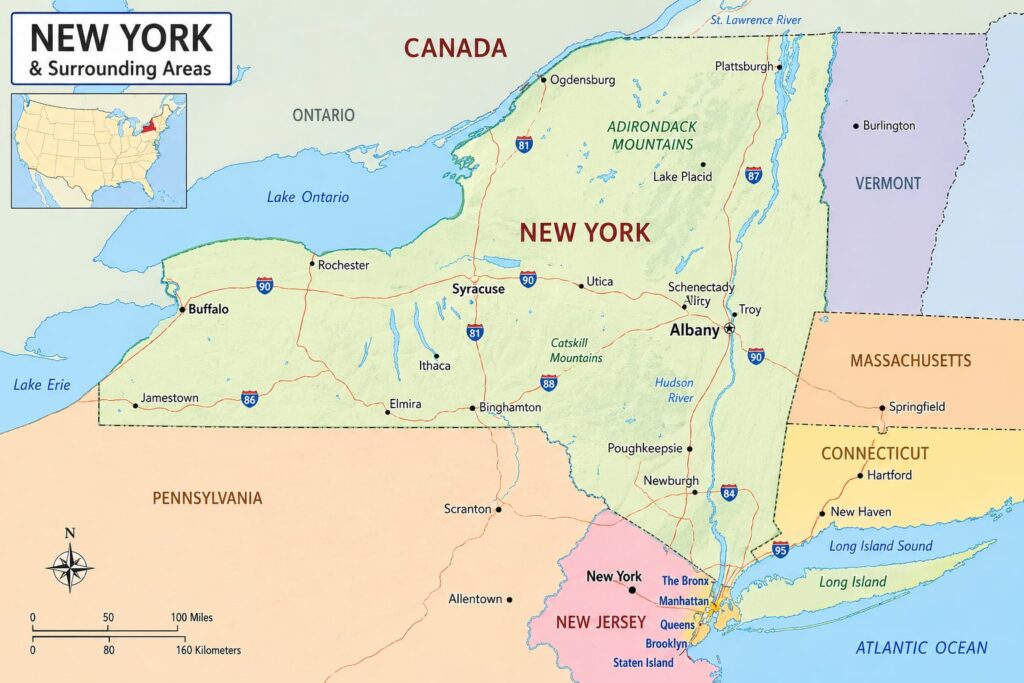
We merge SEO-based inbound marketing (because this gives you compound organic leads in the long run) with outbound marketing (to keep your pipeline full today) and conversion-optimized web design (to turn traffic into leads). Clients of ours from Troy, Schenectady, Colonie, and all across the USA have experienced firsthand the power of the integrated approach that is uniquely possible with SEO Leadz.
Real Results: How an Integrated Lead Generation Approach Works
One of our clients from Albany found themselves only receiving less than 10 qualified leads a month using disparate methods of lead generation. After 90 days of utilizing our integrated approach, consisting of on-page SEO, LinkedIn outreach, and revamping their landing page, this number tripled. This isn’t magic. This is an integrated system in action.
Conclusion: It Will Be Hard Work To Build Your Pipeline
Lead generation for a B2B business cannot be done once. It is a matter of developing an infrastructure and measuring it over a certain period of time. Those who will make it big in 2026 are the ones who manage to integrate their ICP-targeting strategy, multi-channel outreach strategy, AI personalization, and follow-up all together in one single machine. It may seem difficult but there is definitely some method to it.
With the resources provided above in this guide, you will have everything you need. Develop your ICP, select two or three channels you are going to use, design nurture campaigns and measure everything. Consistency is the key to a strong pipeline. Go week by week and watch as your leads start coming by themselves.

Hi, I’m Kashaf Attiq, founder of SEOLeadz. From custom web development and content writing to advanced SEO and guest posting, I turn websites into powerful, lead-generating machines. Stick around for actionable tips, or reach out to scale your business!




3 thoughts on “B2B Lead Generation: The 2026 Comprehensive Guide to Filling Your Sales Funnel”